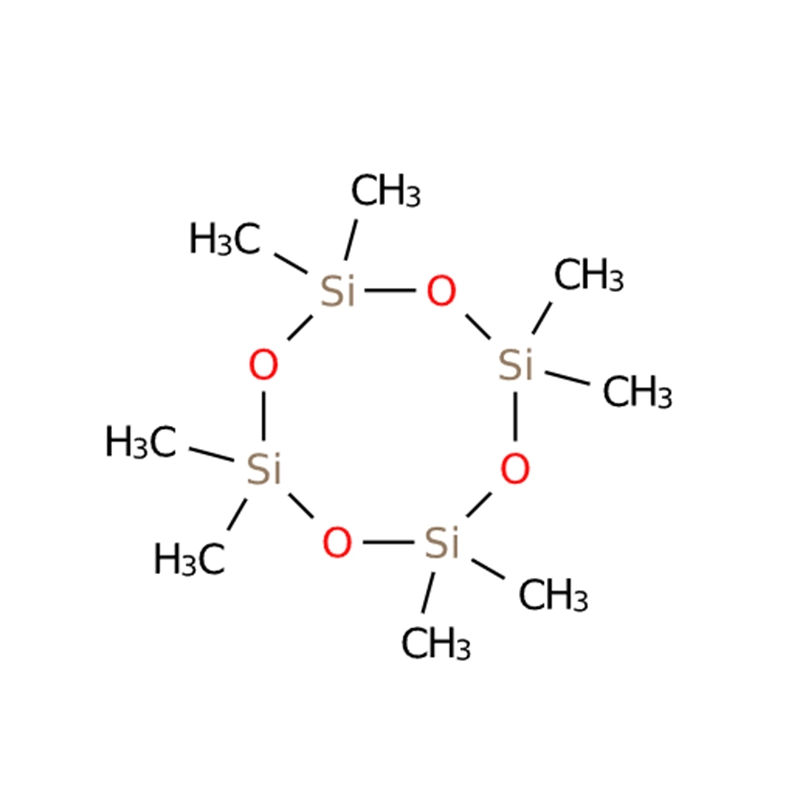
Products Description of Octamethylcyclotetrasiloxane CAS#556-67-2
Octamethylcyclotetrasiloxane, commonly known as D4, is a colorless transparent to milky white, odorless and flammable cyclic siloxane liquid. It is industrially refined through separation and distillation from the hydrolysates of dimethyldichlorosilane, or extracted and purified from cracked hydrolysate mixtures.
Featuring stable cyclic molecular structure and excellent reactive activity, this compound serves as a fundamental and indispensable intermediate throughout the organosilicon chemical industry.
Octamethylcyclotetrasiloxane Chemical Properties
| Melting point | 17-18 °C (lit.) |
| Boiling point | 175-176 °C (lit.) |
| density | 0.956 g/mL at 25 °C (lit.) |
| vapor density | 1 (vs air) |
| vapor pressure | 1.32hPa at 25℃ |
| refractive index | n20/D 1.396(lit.) |
| Fp | 140 °F |
| storage temp. | Store below +30°C. |
| solubility | <0.001g/l Hydrolysis |
| form | liquid |
| color | colorless |
| Specific Gravity | 0.956 |
| explosive limit | 0.4-11.7%(V) |
| Water Solubility | INSOLUBLE |
| Sensitive | Moisture Sensitive |
| Merck | 146747 |
| BRN | 1787074 |
| Dielectric constant | 2.4(20℃) |
| InChIKey | HMMGMWAXVFQUOA-UHFFFAOYSA-N |
| LogP | 6.98 at 21.7℃ |
| CAS DataBase Reference | 556-67-2(CAS DataBase Reference) |
| NIST Chemistry Reference | Cyclotetrasiloxane, octamethyl-(556-67-2) |
| EPA Substance Registry System | Octamethylcyclotetrasiloxane (556-67-2) |
| Hazard Codes | Xn |
| Risk Statements | 53-62-10 |
| Safety Statements | 36/37-46-51-61 |
| RIDADR | UN 1993 3/PG 3 |
| WGK Germany | 1 |
| RTECS | GZ4397000 |
| TSCA | Yes |
| HazardClass | 3 |
| PackingGroup | III |
| HS Code | 29319090 |
| Hazardous Substances Data | 556-67-2(Hazardous Substances Data) |
| Toxicity | LD50 oral in rat: 1540mg/kg |
Product Application of Octamethylcyclotetrasiloxane CAS#556-67-2
Octamethylcyclotetrasiloxane (D4) acts as a core foundational raw material in the organosilicon industry for synthesizing diverse silicone products. It is widely utilized in the production of conventional and modified silicone oils, silicone emulsions, silicone rubber and silicone resins.
Additionally, In industrial fields, it acts as a lubricant, release agent and surface treatment additive for textiles and plastic products. It can also be used in the production of defoamers and insulating materials for electronic components, boasting versatile applicability in fine chemical and industrial silicone manufacturing fields.